CJC-1295 / Ipamorelin vs Sermorelin: GH Secretagogue Choices
CJC-1295 + Ipamorelin stack vs Sermorelin alone — mechanism differences, GH pulse magnitude, side-effect profiles, and which to choose for which goal.
By PeptidesDB EditorialPublished Jun 14, 20266 min read
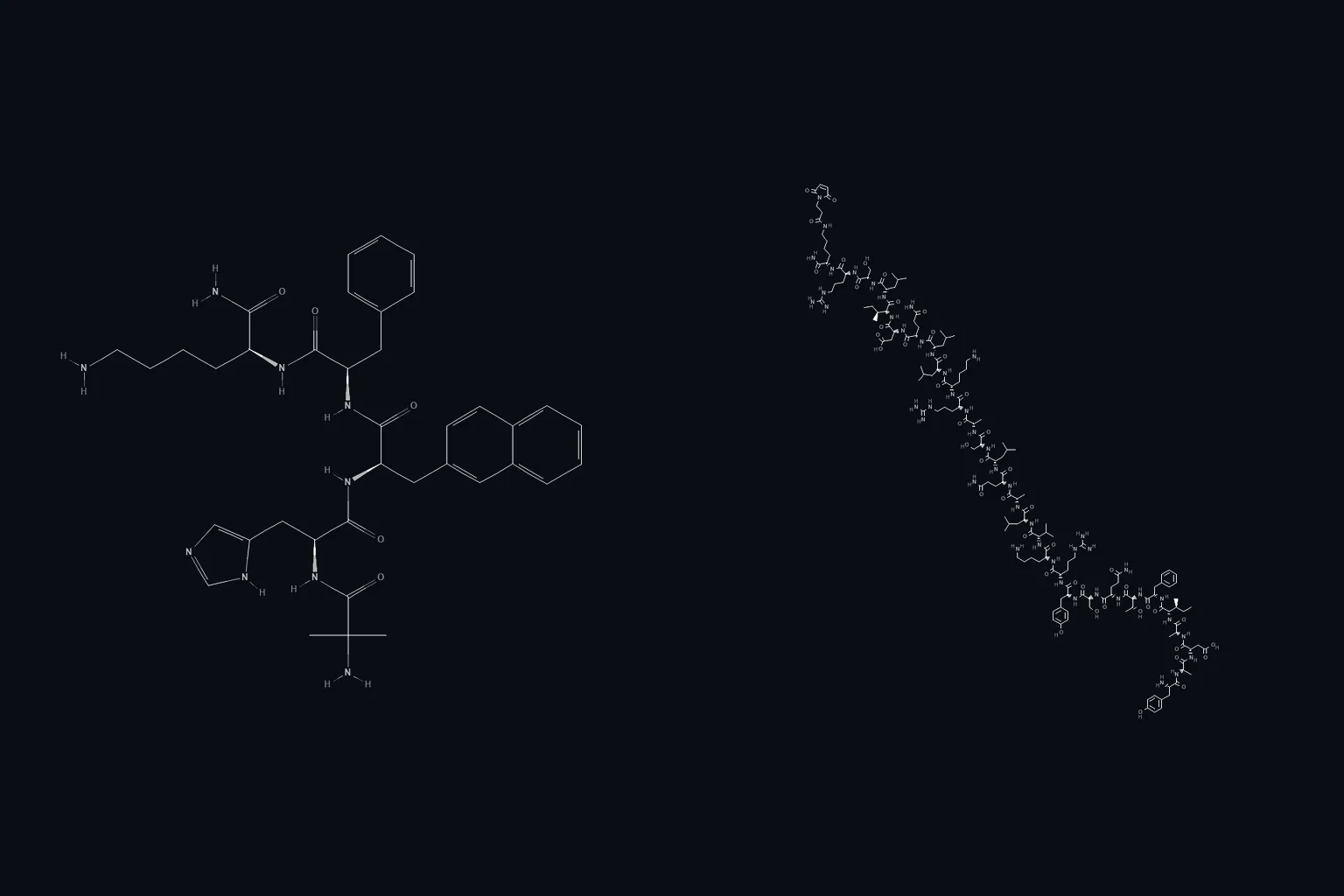
The CJC-1295 + Ipamorelin stack and Sermorelin alone both target the GH axis but at different magnitudes and via different mechanisms. CJC-1295 + Ipamorelin is the stronger combination — two complementary receptors activated simultaneously. Sermorelin is the older, milder GHRH analog used for clinical GH-replacement-style protocols. This article compares them on mechanism, magnitude, side effects, and choice criteria.
For the comparison of just the two GHRPs in the stack, see Ipamorelin vs CJC-1295. For the broader landscape see peptides for muscle growth.
Quick verdict table
| Sermorelin | CJC-1295 + Ipamorelin stack | |
|---|---|---|
| Class | GHRH analog (alone) | GHRH analog + GHRP combination |
| Mechanism | GHRH receptor only | GHRH receptor + ghrelin receptor (simultaneous) |
| Effect magnitude | Mild — physiological pulse | Moderate — synergistic pulse, larger than either alone |
| Half-life | ~10 min (very short) | CJC-1295 without DAC ~30 min; Ipamorelin ~2 h |
| Dosing | 200–500 mcg SC nightly | CJC 100 mcg + Ipa 200–300 mcg, 1–3×/day SC |
| Safety profile | Excellent — gentlest of the GH-axis peptides | Excellent — Ipamorelin is the cleanest GHRP |
| Approval | FDA-approved (historically); discontinued by manufacturer; available via compounding | Research-use compounds; compounding-pharmacy availability tightening |
| Best for | Mild GH support; clinic-prescribed deficiency protocols; first-time user wanting minimum risk | Body composition, recovery, the user wanting a larger GH pulse with controlled side effects |
Mechanism
Sermorelin
A 29-amino-acid analog of growth-hormone-releasing hormone (GHRH 1-29). Binds the GHRH receptor on pituitary somatotrophs and triggers a discrete, physiological GH pulse. The pulse magnitude depends on the user's baseline pituitary capacity — Sermorelin doesn't override the body's normal regulation, it just nudges it.
Half-life is very short (~10 min). The clinical practice is bedtime dosing, where Sermorelin amplifies the user's normal nocturnal GH pulse.
CJC-1295 + Ipamorelin
Two receptors activated at the same time:
- CJC-1295 (without DAC) — modified GHRH analog. Same receptor as Sermorelin; longer half-life (~30 min) and more stable.
- Ipamorelin — selective ghrelin receptor agonist; minimal cortisol/prolactin spike.
GHRH receptor + ghrelin receptor activation is synergistic — the combined pulse is meaningfully larger than the sum of either alone. This is the underlying reason the stack works better than either compound used alone.
For the within-stack comparison, see Ipamorelin vs CJC-1295.
What each is best for
Sermorelin
- Documented adult growth-hormone deficiency under clinician supervision. Historically the standard non-HGH option.
- First-time GH-axis user who wants the gentlest possible introduction.
- Older patients (Sermorelin works best in users whose baseline GH-axis is somewhat intact but reduced).
- Sleep emphasis rather than body-composition emphasis.
CJC-1295 + Ipamorelin stack
- Body composition (modest lean-mass gain, modest fat reduction) over an 8–12 week cycle.
- Recovery from training-heavy weeks.
- Sleep (similar nocturnal amplification but stronger than Sermorelin).
- Users who want a larger GH pulse than Sermorelin can deliver, with controlled side effects.
Side-effect profile
Sermorelin
- Common: Very mild. Occasional injection-site irritation. Mild facial flushing for a few minutes post-dose (the GHRH effect, harmless).
- Less common: Mild headache.
- Notable absence: The gentlest profile of any GH-axis peptide. Effectively no cortisol/prolactin elevation; effectively no glucose effect short-term.
CJC-1295 + Ipamorelin stack
- Common: Mild flushing at injection (CJC effect), occasional headache, slight drowsiness post-dose (often desired).
- Less common: Mild fluid retention with prolonged cycles, occasional joint discomfort.
- Notable absence: Both components have clean cortisol/prolactin profiles relative to other GHRPs (Ipamorelin's selectivity + CJC's specificity).
How to choose
A decision frame:
- You have documented adult GH deficiency under clinician care? Sermorelin or Tesamorelin (FDA-approved). Standard endocrinology.
- You're a first-time GH-axis user, side-effect-averse, want the gentlest possible introduction? Sermorelin alone for 4–6 weeks, assess effects.
- You want body-composition or recovery emphasis at clinical doses? The CJC-1295 + Ipamorelin stack — larger pulse, more visible effect on the relevant endpoints.
- You're cycling more than once a year? The stack — the effect magnitude justifies the slight side-effect step-up.
- You're older (>60), have not done GH-axis peptides before, want a controlled start? Sermorelin.
- You're younger, training hard, want recovery + body comp from a single peptide stack? The CJC + Ipa stack.
Dosing comparison
Sermorelin
- 200–500 mcg subcutaneously, once per day before bed.
- 8–12 weeks on, 4 weeks off.
- Effect builds over the first 2–3 weeks (the GH-axis response normalizes).
CJC-1295 + Ipamorelin
- CJC-1295 (without DAC) 100 mcg + Ipamorelin 200–300 mcg in a single subcutaneous injection.
- 1–3× per day. Most common: 1× before bed (single-dose simplicity) or 2× per day (morning fasted + evening).
- 8–12 weeks on, 4 weeks off.
- Effect onset within first week.
For reconstitution math, use the calculator. For technique see how to inject peptides.
Stacking either with other peptides
Sermorelin + Ipamorelin is itself a valid stack (same mechanism as CJC + Ipa but with Sermorelin's shorter-acting GHRH instead of the more-stable CJC). Cleaner option for users who specifically want the minimum-risk profile. Less common in modern practice.
CJC-1295 + Ipamorelin + GHRP-2 or Hexarelin — a "triple stack" pattern occasionally seen. Not recommended for most users; adding a second GHRP doesn't proportionally increase GH but does increase cortisol/prolactin spike risk.
CJC-1295 + Ipamorelin + Tesamorelin — used in some specialty practices for body-composition emphasis. Combines two GHRH-style inputs with one GHRP. Mechanism overlap is meaningful; stronger evidence base is needed before recommending.
Safety frame
GH-axis manipulation requires monitoring regardless of which option:
- Baseline IGF-1, fasting glucose, HbA1c, lipid panel.
- Repeat at 8 weeks and 16 weeks.
- Watch for: fluid retention, joint discomfort, glucose elevation (Sermorelin minimal; CJC + Ipa modest), carpal-tunnel symptoms.
- Cancer-history exclusion: IGF-1 promotes growth signaling. Do not run without oncology sign-off if any personal or family cancer history.
See are peptides safe? and peptide side effects.
What about MK-677 instead?
MK-677 (Ibutamoren) is an oral ghrelin-receptor agonist — same receptor class as Ipamorelin, but oral and continuous rather than injectable and pulsed. Different physiology: sustained GH-axis activation rather than discrete pulses, with more appetite increase, more glucose effect long-term, and more water retention.
MK-677 is the natural alternative for users who want oral convenience. It is not equivalent to the CJC + Ipa stack — different mechanism profile, different side-effect profile.
Bottom line
- Sermorelin alone: mild, physiological, lowest-risk GH support. Best for first-time users, older users, deficiency-replacement protocols.
- CJC-1295 + Ipamorelin stack: moderate, synergistic, larger GH pulse with controlled side effects. Best for body composition, recovery, sleep emphasis at meaningful magnitudes.
- Both require monitoring; both should be cycled, not run continuously.
Operational guides: how to reconstitute, how to inject, calculator, peptide cycling.