Ipamorelin vs CJC-1295: Mechanism, Effects, and Why They're Stacked
Ipamorelin and CJC-1295 work on different receptors and are commonly combined. Here's how they compare individually and why the stack produces a larger GH pulse than either alone.
By PeptidesDB EditorialPublished Jun 14, 20266 min read
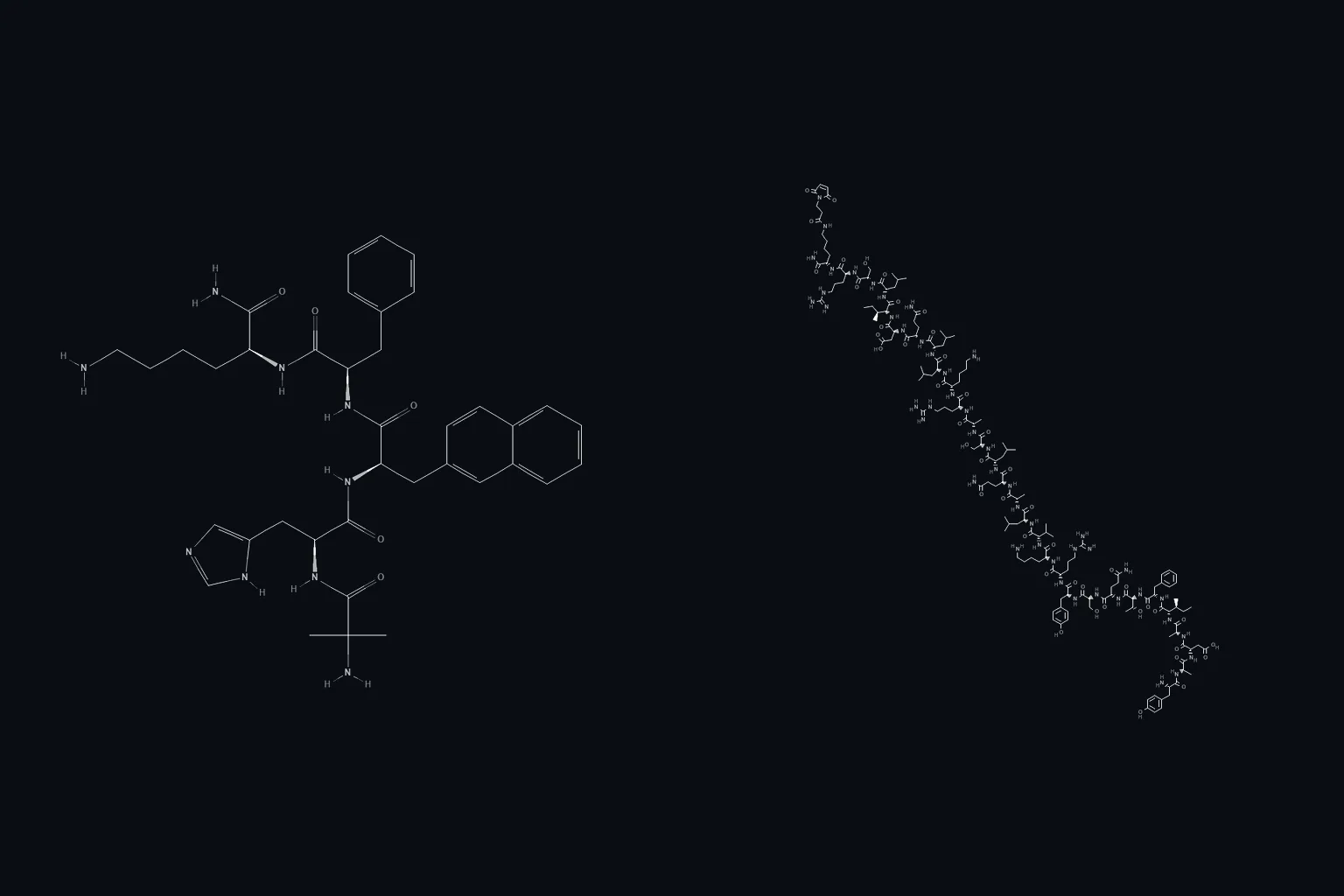
Ipamorelin and CJC-1295 are both growth hormone secretagogues, but they work through different receptors. Ipamorelin is a GHRP (acts on the ghrelin receptor); CJC-1295 is a GHRH analog (acts on the GHRH receptor). They're commonly stacked because activating both receptors produces a larger GH pulse than activating either alone. This article covers both compounds, their differences, side effects, and why the stack works.
For per-peptide profiles, see Ipamorelin and CJC-1295.
Quick verdict table
| Ipamorelin | CJC-1295 | |
|---|---|---|
| Class | GHRP (ghrelin receptor agonist) | GHRH analog |
| Mechanism | Stimulates pituitary GH release via ghrelin receptor | Stimulates pituitary GH release via GHRH receptor |
| Half-life | ~2 hours | Without DAC: ~30 min. With DAC: ~6–8 days |
| Selectivity | Highly selective — minimal cortisol/prolactin spike | Selective for GHRH-R |
| Typical dosing | 200–300 mcg, 2–3×/day SC | Without DAC: 100 mcg 1–3×/day SC. With DAC: 1–2 mg once weekly SC |
| Common stack partner | CJC-1295 (without DAC) | Ipamorelin |
| Common side effects | Very mild | Mild flushing, occasional headache |
| Often used for | Recovery, sleep, body comp | Body comp, sleep |
| Best for | First-time GH-axis user, side-effect-averse | User who wants longer-acting GH support or stack base |
What each peptide actually is
Ipamorelin
A synthetic pentapeptide engineered as a selective ghrelin-receptor agonist. The selectivity is the key feature: ghrelin's other actions (hunger stimulation, cortisol and prolactin elevation) are minimized. Ipamorelin produces a clean GH pulse without the appetite spike of GHRP-6 or the cortisol/prolactin elevation of GHRP-2 and Hexarelin.
CJC-1295
A modified GHRH (growth-hormone-releasing hormone) analog. Two variants are commercially distinct:
- CJC-1295 without DAC (also called Mod GRF 1-29) — modified at four positions for stability. Half-life ~30 minutes. Used in 1–3× daily dosing, often stacked with a GHRP.
- CJC-1295 with DAC — adds a drug-affinity complex (DAC) that binds the peptide to serum albumin. Extends the active half-life to ~6–8 days. Sustained GH-axis elevation rather than discrete pulses.
The two are often confused. They produce meaningfully different physiology — without DAC gives discrete GH pulses (more physiological), with DAC gives a constant low-level elevation (less physiological).
How they differ mechanistically
GH release from the pituitary is regulated by two upstream signals:
- GHRH (from the hypothalamus) — tells the pituitary to make and release GH.
- Ghrelin (from the stomach) — amplifies the GHRH response and also produces GH release directly.
Activating only the GHRH receptor (CJC-1295 alone) produces a modest pulse. Activating only the ghrelin receptor (Ipamorelin alone) also produces a modest pulse. Activating both at the same time produces a larger pulse than the sum — the two signals amplify each other.
This is the underlying reason for the stack.
The stack: CJC-1295 (without DAC) + Ipamorelin
The most-common pattern:
- CJC-1295 without DAC 100 mcg + Ipamorelin 200–300 mcg, mixed in a single subcutaneous injection.
- 1–3× daily. The most-cited pattern is 1× before bed (amplifying the natural nocturnal GH pulse) or 2× per day (morning fasted + evening).
- 8–12 weeks on, 4 weeks off.
Either component used alone is functional. The stack just produces more GH per dose.
The CJC-1295 with DAC + Ipamorelin combination exists but is less common. The continuous GH-axis elevation from CJC-with-DAC dampens the discrete pulse benefit of co-administered Ipamorelin; the without-DAC variant pairs better.
Side effects
Ipamorelin
- Common: Very mild. Occasional injection-site irritation. Mild flushing in the first few doses.
- Less common: Headache. Lightheadedness.
- Notable absence: Negligible cortisol or prolactin spike — the cleanest GHRP in this regard.
CJC-1295
Without DAC:
- Common: Mild facial flushing at injection (the GHRH effect, harmless), occasional headache, slight tingling in extremities for a few minutes.
- Less common: Drowsiness post-dose (often desired).
With DAC:
- Common: Same as without DAC but persistent (continuous low-level effect).
- Notable: The continuous GH-axis elevation can produce more water retention and more joint discomfort than discrete pulsed dosing. Less physiological.
Stack-specific
When combined, the dominant side effects are still mild — flushing, occasional headache. The cleaner of the two GHRPs (Ipamorelin) and the cleaner pulse from without-DAC CJC-1295 keep the stack tolerable for most users.
What to expect
At reasonable doses across 8–12 weeks:
- Sleep improvement — most consistent subjective effect; amplified slow-wave sleep.
- Recovery — faster soreness clearance from training.
- Body composition — modest fat-mass reduction, small lean-mass gain. More noticeable in users training consistently than in sedentary users.
- Skin and connective tissue — fingernails grow faster; some users report skin-quality changes.
These are not steroid-tier numbers. The honest expectation: a useful adjuvant to training and recovery, not a transformation.
Who each is better for
- First-time GH-axis user — Ipamorelin alone. Cleanest profile, easiest to attribute effects to.
- Side-effect-averse — Ipamorelin alone or the stack with low-dose CJC.
- Wants larger GH pulse — the stack (CJC-1295 without DAC + Ipamorelin).
- Wants less-frequent dosing convenience — CJC-1295 with DAC, accepting the less-physiological continuous profile.
- Recovering from training-heavy weeks — the stack, dosed pre-bed.
What about Sermorelin, Hexarelin, MK-677?
| Ipamorelin | CJC-1295 (without DAC) | Sermorelin | Hexarelin | MK-677 | |
|---|---|---|---|---|---|
| Class | GHRP | GHRH analog | GHRH analog | GHRP | Oral GHS |
| Effect strength | Moderate, clean | Moderate, clean | Mild | Strong | Sustained, oral |
| Cortisol/prolactin spike | Negligible | Minimal | Minimal | Present | Minimal |
| Best for | First-time GHRP | Stack base | Mild support | Strong pulse | Oral convenience |
Sermorelin is an older, milder GHRH analog. Hexarelin is a stronger GHRP but with more cortisol/prolactin elevation. MK-677 is oral, daily, and produces sustained GH-axis activation rather than discrete pulses.
For the broader landscape, see peptides for muscle growth and the muscle-growth hub.
Safety frame
GH-axis peptides require monitoring. Standard:
- Baseline IGF-1, fasting glucose, HbA1c, lipid panel.
- Repeat at 8 weeks and 16 weeks.
- Watch for: fluid retention, joint discomfort, carpal-tunnel symptoms, glucose elevation.
- Stop if any persistent symptom unexplained by other causes.
Cancer-history exclusion: IGF-1 promotes growth signaling. Anyone with personal or family cancer history should not run GH-axis peptides without oncology sign-off.
See are peptides safe? and peptide side effects.
Bottom line
- Ipamorelin and CJC-1295 (without DAC) are mechanistically complementary — different receptors, additive GH response.
- The stack is the standard pattern; either alone is functional but milder.
- Both are well-tolerated at clinical doses; Ipamorelin specifically has the cleanest side-effect profile in the GHRP class.
- Use only with monitoring; cycle don't run continuous.
Operational guides: how to reconstitute peptides, how to inject peptides, calculator, peptide cycling.