Peptide Injections: A Practical Reference Guide
Everything about peptide injection — supplies, subcutaneous vs intramuscular, sites and rotation, dosing math, what to watch for, and when to escalate to a clinician.
By PeptidesDB EditorialPublished Jun 14, 20266 min read
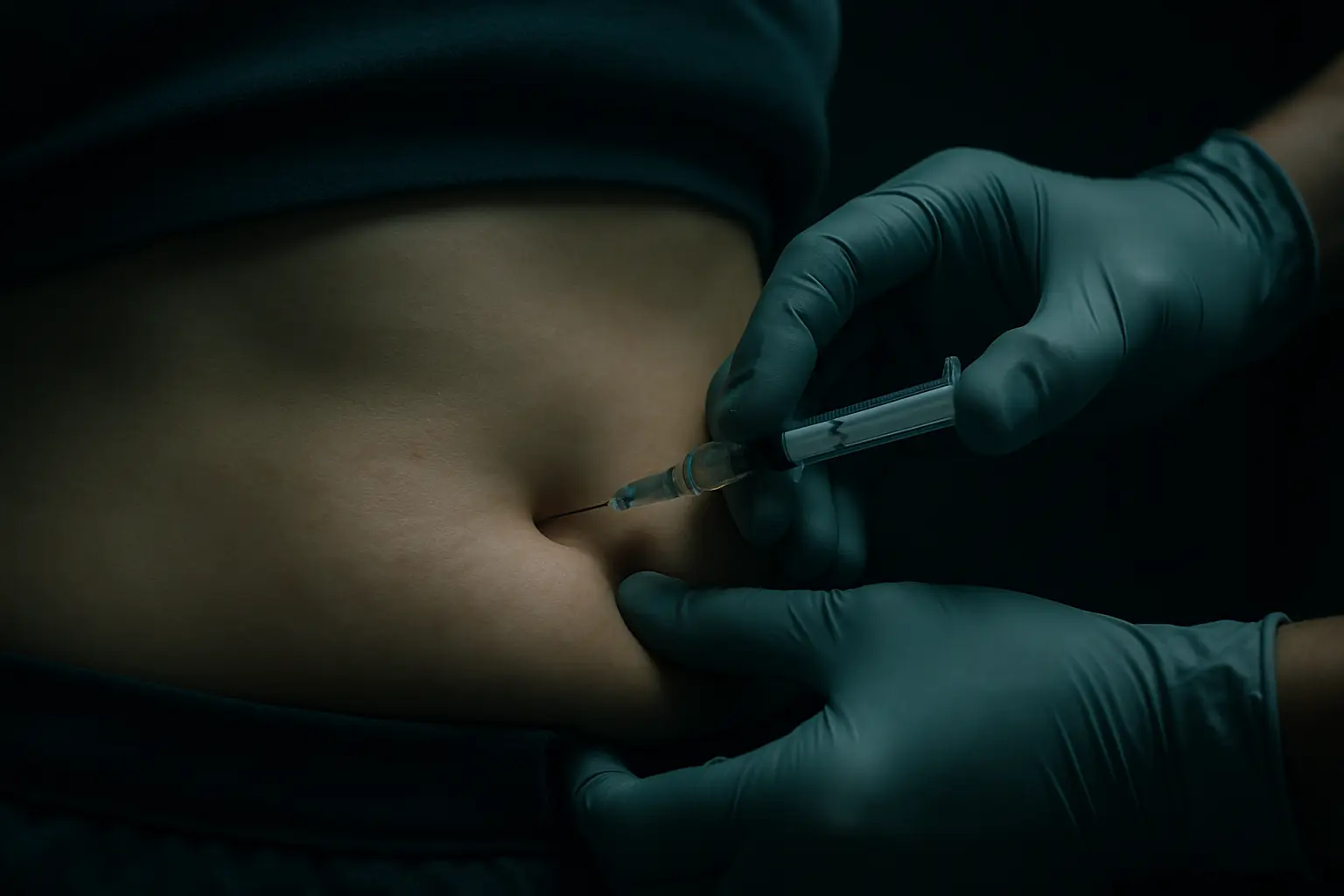
Most research peptides are injected subcutaneously with a short U-100 insulin syringe. The injection takes about thirty seconds once you've done it a few times. This article is the consolidated practical reference — supplies, technique, math, sites, troubleshooting, when to escalate.
For the focused step-by-step articles, see how to inject peptides and where to inject peptides. For the broader operational frame, see how to use peptides.
Supplies
A complete kit:
- The reconstituted peptide vial, refrigerated. (Not yet reconstituted? See how to reconstitute peptides.)
- Bacteriostatic water for reconstitution. (Why BAC water specifically.)
- U-100 insulin syringes — 1 mL barrel with 29G–31G short needle (5/16" or 8 mm). Half-mL barrels are also fine for small doses (finer graduations).
- Alcohol swabs.
- A sharps container — proper container preferred; a thick-walled opaque screw-top bottle is the minimum acceptable household substitute.
Subcutaneous vs intramuscular
For nearly every peptide in the research library, subcutaneous (SC) injection is the default. Reasons:
- Slower, steadier absorption than intramuscular (IM) — preferred for peptides that work better via sustained exposure.
- Less painful — short, fine insulin needles into a pinched fat fold are barely felt.
- Easier rotation across sites — abdomen, thighs, arms, glutes all viable.
- Lower bleeding risk.
A few peptides have specific routes called out in the original research — usually IM for higher-volume doses (HCG sometimes IM, certain GH-axis protocols). When in doubt, default to SC; check the per-peptide page in the library for compound-specific guidance.
The injection procedure
The 30-second loop, once supplies are out:
- Pull the vial from the fridge. Let it warm 2–3 minutes for comfort.
- Wash hands.
- Swab the vial stopper. Air-dry.
- Draw the dose. Pull air into the syringe equal to dose volume, push into vial, invert, draw to dose mark. Tap bubbles up, push them out, confirm dose mark.
- Pick + swab the site. Abdomen (avoiding 2" around navel), outer thigh, upper-outer arm, upper-outer buttock. Air-dry the alcohol.
- Pinch a fold of skin and fat. Insert needle at 90° (45° for very lean sites). Push plunger steadily.
- Withdraw, release pinch, dab if needed. Discard syringe into sharps container.
For the full mechanics see how to inject peptides. For site selection and rotation see where to inject peptides.
Dosing math
The unit conversion that trips most people up:
- Vial concentration (mg/mL) = vial mg ÷ BAC water mL.
- Dose volume (mL) = dose mg ÷ concentration mg/mL.
- Syringe units = dose volume × 100 for a U-100 insulin syringe.
Worked example: 5 mg vial of BPC-157 + 2 mL BAC water = 2.5 mg/mL. A 250 mcg (0.25 mg) dose = 0.1 mL = 10 units on a U-100 syringe.
The free calculator does the math + validates the per-dose volume is something your syringe can actually measure (warns on awkward ratios).
Frequency
Peptide-dependent. Examples:
| Peptide | Typical frequency |
|---|---|
| BPC-157 | Daily, sometimes twice daily |
| TB-500 | 2× weekly loading → weekly maintenance |
| Ipamorelin + CJC-1295 (no DAC) | 1–3× daily |
| MK-677 | Daily (oral, not injected) |
| Semaglutide / Tirzepatide | Once weekly |
| Cagrilintide | Once weekly |
| GHK-Cu (injectable) | Cycled monthly |
| Selank / Semax | Daily during 10–14 day courses |
| Epitalon | Daily during 10–20 day annual cycle |
See the per-peptide page in the library for compound-specific dosing.
What "normal" feels like
After a clean SC injection:
- A tiny pinch when the needle enters skin.
- Brief mild burn or stretch when the plunger goes in (1–2 seconds).
- A small bead of blood at withdrawal in maybe 1 in 10 injections — apply slight pressure for a few seconds.
- A small bruise (quarter-sized purple) at the site within hours, sometimes. Resolves in a day or two.
- A small itchy welt for a few hours, sometimes. Normal mast-cell response.
If a site is significantly more uncomfortable than usual, the most common explanations are: needle was dull (reuse), injection too close to a prior site, cold injectate (didn't warm 2–3 min), or alcohol wasn't dry.
When to escalate
Stop and consult a clinician if:
- Spreading redness, warmth, or pus at the site — possible cellulitis.
- Fever within hours of a dose, no other obvious cause.
- A hard nodule persisting more than 2–4 weeks — possible lipohypertrophy or granuloma.
- Hives, throat tightness, breathing difficulty, facial swelling — anaphylaxis is a medical emergency.
- Any unexplained systemic symptom following a new vial or new compound.
The most common cause of unexpected systemic symptoms after a peptide dose is endotoxin contamination of the product (lipopolysaccharide from bacterial expression hosts). Switch lot, switch supplier, reassess. See are peptides safe? for the full discussion of product-quality risk.
Sharps disposal
Used insulin syringes go into a sharps container. Many US municipalities have free pharmacy or fire-station drop-off; some mail-back programs exist. A thick-walled, opaque, screw-top container is the minimum acceptable substitute if a real container isn't available.
Do not put used syringes into:
- Household trash bags
- Recycling
- Loose in any container the public might handle
Storage of supplies
| Item | Storage | Notes |
|---|---|---|
| Lyophilized peptide vial (unopened) | Room temperature OK for weeks; refrigerate for years | Avoid heat and humidity |
| Reconstituted peptide vial | 2–8 °C refrigerated | 4–8 weeks typical stability; peptide-dependent |
| BAC water vial (sealed) | Room temperature, years | Manufacturer expiration applies |
| BAC water vial (post-puncture) | Room temperature; USP labels up to 28 days | Preservative depletes |
| Insulin syringes | Room temperature, sealed package | Indefinite |
| Alcohol swabs | Room temperature | Replace if dried out |
Common operational mistakes
- Reusing a dull needle. Insulin needles are designed for one skin entry. Reuse hurts more and increases site-irritation risk.
- Not rotating sites. Same-site repeat causes lipohypertrophy and erratic absorption.
- Wrong BAC volume on reconstitution. Produces wildly wrong per-dose math. Use the calculator.
- Shaking the vial during reconstitution. Swirl gently. Shaking creates foam and can damage peptide.
- Injecting cold injectate. Stings more. 2–3 min at room temperature first.
- Injecting through wet alcohol. Stings. Wait the few seconds.
- Skipping the air-equalization step. Makes the plunger fight you and creates more bubbles.
Where to go from here
- Run dose math → calculator.
- Step-by-step injection technique → how to inject peptides.
- Site selection + rotation → where to inject peptides.
- Reconstitution → how to reconstitute peptides.
- BAC water guide → BAC water for peptides.
- Safety frame → are peptides safe?, peptide side effects.