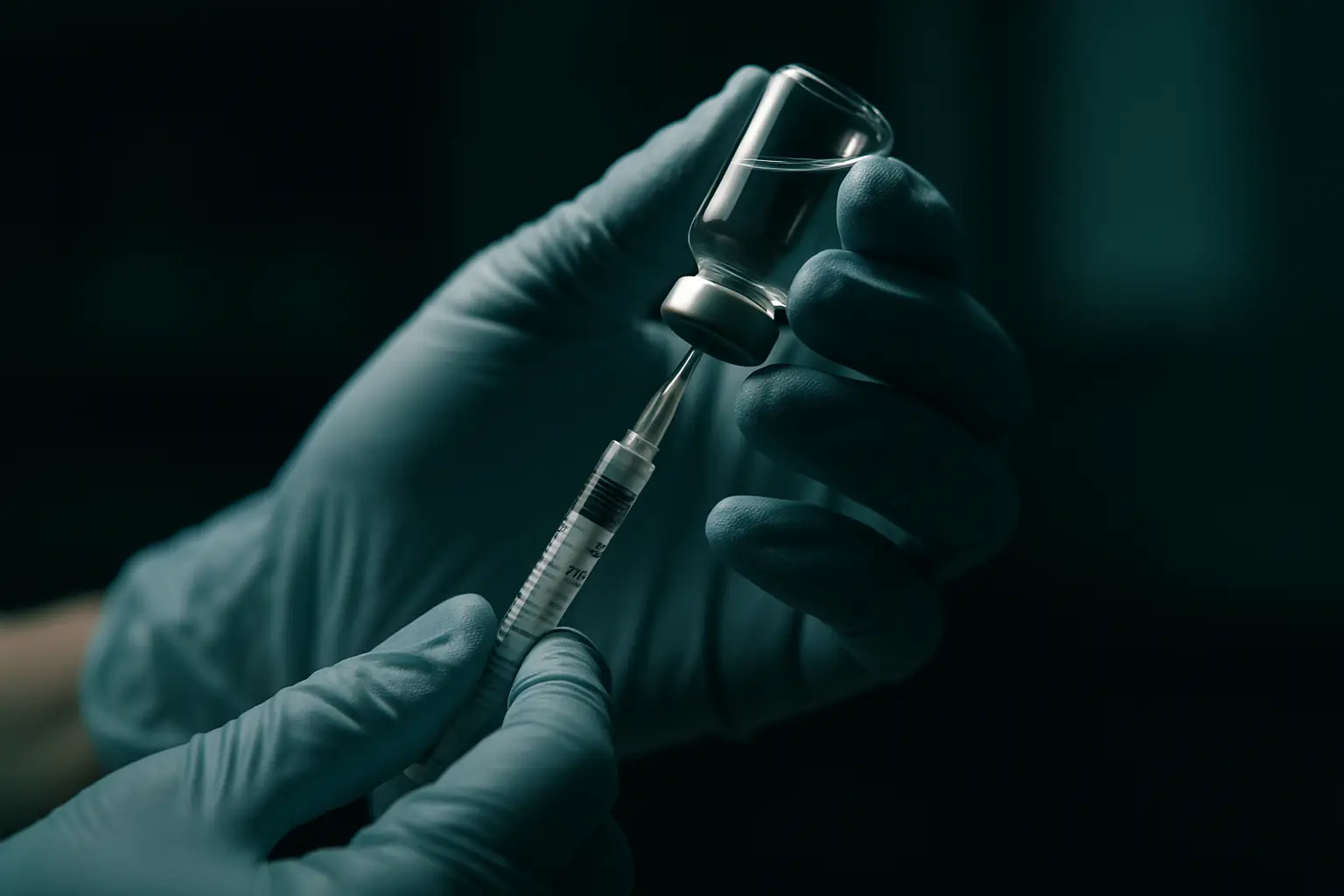
BAC Water for Peptides: What It Is, Why It Matters
Bacteriostatic water is the standard solvent for reconstituting research peptides. Here's what it is, why peptides need it, and how to choose, store, and use it correctly.
By PeptidesDB EditorialPublished Jun 14, 20265 min read
Bacteriostatic water (BAC water) is sterile water containing 0.9% benzyl alcohol — a preservative that suppresses bacterial growth so a reconstituted peptide vial stays usable across multiple doses for weeks at refrigerator temperature. It is the standard solvent for nearly every freeze-dried research peptide. Plain sterile water and saline are not interchangeable.
What bacteriostatic water actually is
BAC water is, chemically, water for injection (WFI) with 0.9% benzyl alcohol added as a preservative. Benzyl alcohol is bacteriostatic (it stops bacteria from reproducing) at that concentration; it is not strongly bactericidal (it does not aggressively kill them on contact). The practical consequence is that a reconstituted peptide solution stored in a sealed vial can be re-entered many times across days or weeks without the contents becoming a microbial broth.
Sterile water for injection (no preservative) and 0.9% sodium chloride (saline, no preservative) are also commonly available. Both are appropriate for single-use reconstitution but provide no protection against bacterial growth after the first puncture of the vial stopper.
Why peptides need BAC water specifically
Most research peptides — BPC-157, TB-500, Ipamorelin, CJC-1295, Semaglutide and similar compounds — are shipped as a lyophilized (freeze-dried) powder inside a sealed glass vial. The freeze-dried form is shelf-stable for months to years at room temperature. The reconstituted solution is dramatically less stable: refrigerated, most peptides remain potent for roughly four to eight weeks; at room temperature, days to a couple of weeks at best.
If you reconstitute with plain sterile water, you have a sterile solution at the moment of mixing — but every subsequent needle puncture introduces a small bacterial load from the rubber stopper, the skin, and the air. Without a preservative, that load multiplies over time. With BAC water, the benzyl alcohol holds the count down to a level that the body's normal defenses can handle if you accidentally inject a small amount of contaminated solution.
For any peptide you intend to use across more than a couple of doses, BAC water is the correct choice.
BAC water vs sterile water vs saline
| Solvent | Preservative | Multi-use? | Typical peptide use |
|---|---|---|---|
| Bacteriostatic water | 0.9% benzyl alcohol | Yes (up to ~28 days per US labeling) | Default for most peptides |
| Sterile water for injection | None | Single use | Single-dose peptide trials |
| 0.9% saline (preservative-free) | None | Single use | Some clinical injectables; rarely peptides |
| Bacteriostatic saline | 0.9% benzyl alcohol | Yes | Functionally equivalent to BAC water for most peptides |
A few peptides specify a particular solvent on the manufacturer's certificate of analysis — for instance, some highly hydrophobic compounds are reconstituted with a mix of sterile water and a small amount of acetic acid or ethanol. Always check the supplier's documentation; default to BAC water otherwise.
How much BAC water to use
The answer determines your final concentration, which then determines how many syringe units equal one dose. The math is straightforward:
- Concentration (mg/mL) = vial powder (mg) ÷ BAC water added (mL).
- Syringe units per dose = (dose in mg ÷ concentration in mg/mL) × 100 (for a U-100 insulin syringe where 100 units = 1 mL).
Worked example: a 5 mg vial of BPC-157 reconstituted with 2 mL of BAC water yields a 2.5 mg/mL solution. A 250 mcg (0.25 mg) dose is 0.1 mL — 10 units on a U-100 syringe.
To skip the arithmetic entirely, use the free reconstitution calculator. It supports common preset peptides and validates that the resulting per-dose volume is something an insulin syringe can actually measure.
For the underlying mixing procedure, see the step-by-step how to reconstitute peptides guide.
Storage and shelf life
Once reconstituted, store the vial in a refrigerator at 2–8 °C. Light is not usually a major concern for short storage periods, but a vial that lives in the back of the fridge is happier than one on the door. Most peptides remain potent for four to eight weeks reconstituted; check the specific peptide's stability profile on its individual page in the library.
A clean technique helps: wipe the stopper with an alcohol swab before every draw, draw with a fresh needle each time if you can, and discard any vial that shows visible particulates, discoloration, or cloudiness regardless of date.
Where BAC water comes from
Pharmacy-supply houses sell BAC water in 10 mL and 30 mL multi-dose vials labeled "Bacteriostatic Water for Injection USP." In the US it is technically a prescription item but is widely available through veterinary and research-supply channels. Sealed vials are stable at room temperature for years.
Common mistakes
A handful of mistakes recur:
- Adding too little BAC water. A 5 mg vial reconstituted in 0.5 mL produces a 10 mg/mL solution where a 250 mcg dose is 0.025 mL — about 2.5 units, hard to measure precisely.
- Adding too much BAC water. Conversely, a 5 mg vial in 5 mL gives a 1 mg/mL solution where a 250 mcg dose is 25 units. Easy to read but the vial empties faster.
- Forcing the BAC water in. Add it slowly down the inner wall of the vial; do not blast it directly onto the powder, which can shear or denature peptide.
- Shaking the vial. Swirl gently or invert. Shaking creates foam, which can degrade peptide and is hard to draw cleanly.
- Reusing a vial past its preservative window. USP labels BAC water as safe for up to 28 days post-puncture; the reconstituted peptide solution is governed by the peptide's own stability profile, which is often longer than 28 days but should never be assumed.
When to use plain sterile water instead
If you are dosing a single time — for instance, a one-time test of a new peptide — sterile water for injection is fine. The cost saving is negligible; the operational complication of remembering which vial uses which solvent is usually not worth it.
Summary
- Default to bacteriostatic water for any peptide you'll dose more than once.
- 0.9% benzyl alcohol gives you a roughly four-week working window per puncture.
- Volume of BAC water determines concentration determines dose volume — use the calculator instead of doing the math wrong by hand.
- Refrigerate after reconstitution; discard if anything looks off.
Once reconstituted, the practical next steps are the same for every peptide: see how to inject peptides for technique and where to inject peptides for site selection.