What Is TB-500? A Research Peptide Explained
What is TB-500? A research-use-only peptide related to thymosin beta-4, not FDA-approved. What the preclinical evidence shows, and the safety unknowns.
By PeptidesDB EditorialPublished Jul 16, 20267 min read
Short answer to what is TB-500: it is a synthetic research peptide related to a naturally occurring protein called thymosin beta-4, studied mainly in laboratory and animal settings for a possible role in tissue repair. It is research-use only and not FDA-approved — not authorized as a medicine, not a legal supplement, and typically sold labeled "for research only" or "not for human consumption." Human clinical evidence for TB-500 is very limited; nearly everything known about it comes from preclinical work, and preclinical work does not establish that something is safe or effective in people. This page is educational only and includes no dosing, reconstitution, sourcing, or administration information.
What Is TB-500, and How It Relates to Thymosin Beta-4
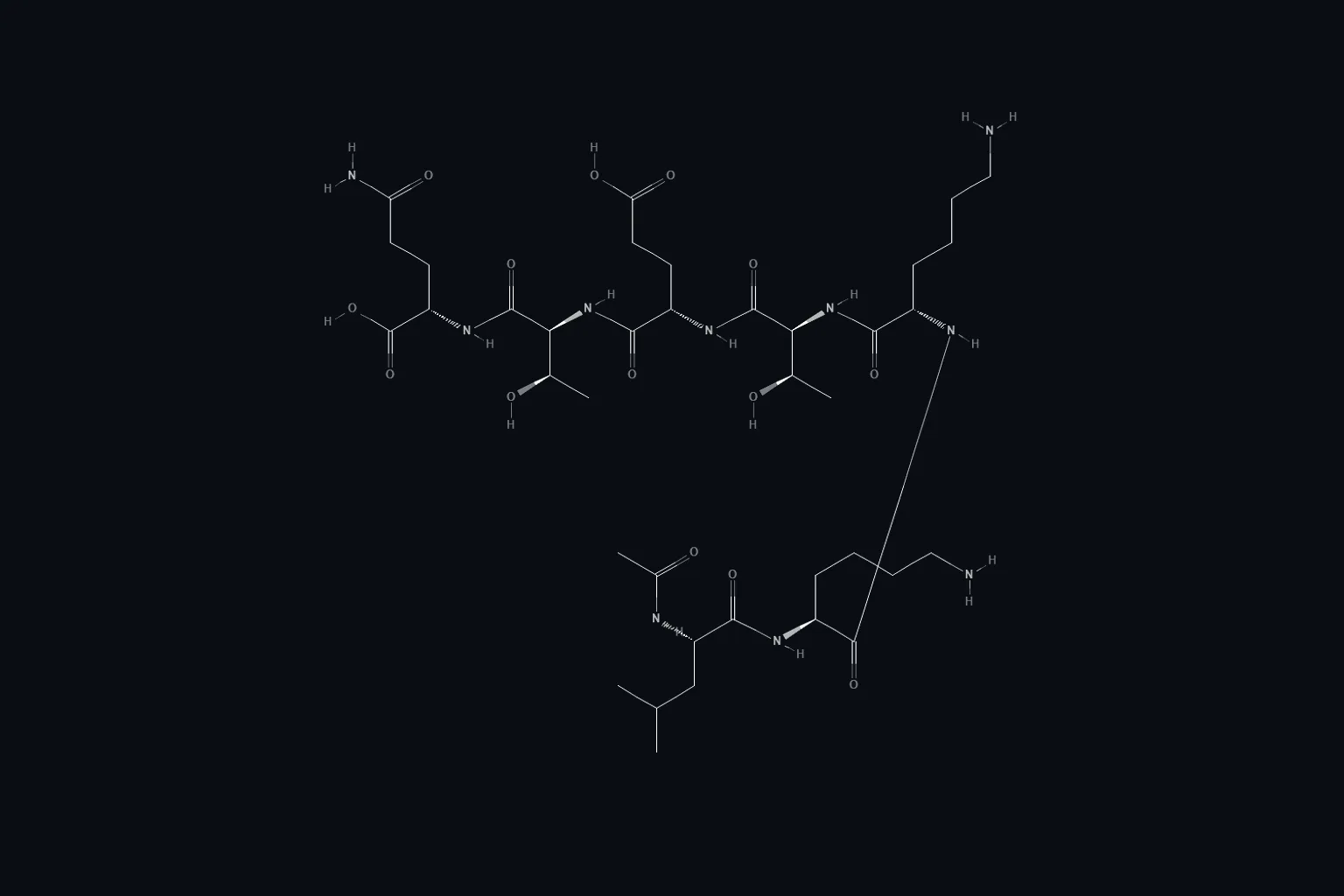
TB-500 is a lab-made peptide corresponding to an active region of thymosin beta-4 (TB4), a small protein present in many tissues and involved in basic cellular processes. TB-500 is not the same molecule as TB4. It is a fragment — a short sequence drawn from the larger protein — synthesized separately and studied to explore effects associated with TB4.
That distinction matters more than the marketing suggests. A fragment does not automatically reproduce the behavior of the full protein: proteins fold, and the shape of the whole determines much of what it does. Whether a fragment recapitulates, partially reproduces, or diverges from the parent protein's activity is an empirical question that has to be answered rather than assumed. Marketing that treats "TB-500" and "thymosin beta-4" as interchangeable is glossing over exactly that question. Despite heavy promotion — including in veterinary contexts and among athletes — TB-500 has not been approved by the FDA for human medical use.
What Researchers Have Studied It For
Thymosin beta-4 is known to participate in cell migration and in the organization of actin, a structural protein inside cells. Both processes plausibly matter to how tissue repairs itself, since repair requires cells to move into a damaged area and rebuild structure. On that basis, researchers have studied TB-500 in preclinical models for possible effects on:
- Cell migration relevant to wound closure and tissue repair
- Tissue and muscle recovery in animal injury models
- Blood-vessel formation and structural remodeling, studied at the cellular level
- Inflammatory signaling in animal models
These are research questions, not established human benefits. Laboratory and animal findings frequently do not carry over to people, and the fact that a mechanism sounds plausible is not evidence that it produces a meaningful result in a human body.
What the Evidence Shows — and Where It Stops
The evidence for TB-500 is predominantly preclinical: cell and animal studies rather than large, controlled human trials. Some animal research has explored repair-related effects, which is what fuels the interest.
The limits are worth naming precisely:
- Human clinical data are sparse. Robust controlled trials in people are largely absent — not conflicting, absent.
- Preclinical results are not proof. Animal outcomes often fail to replicate in humans, which is the ordinary outcome in drug development rather than a rare disappointment.
- Related research is not the same research. Clinical investigation of thymosin beta-4 itself in certain contexts is sometimes cited as though it validates TB-500. It does not. Different molecule, different question.
- Marketing exceeds evidence. Many claims about TB-500 go well beyond anything published.
We avoid citing specific numbers because the underlying research is preliminary and not directly applicable to human use. A precise-sounding figure from an animal model does not become more relevant to you by being repeated.
The Fragment Problem, Stated Plainly
This deserves its own treatment because it is the most common misunderstanding after regulatory status. The pitch for TB-500 leans on thymosin beta-4's known biology. But the pitch and the product are not the same thing.
TB4 is a full protein with a defined structure. TB-500 is a synthetic fragment. Assuming the fragment does what the protein does is a hypothesis, and one that preclinical work is meant to test rather than presuppose. Compounding this, what is sold as "TB-500" in the unregulated market is not verified to be any particular sequence at all — so a buyer is stacking an unverified product on top of an unproven fragment on top of an extrapolation from a different molecule. Each step is a place where the reasoning can fail, and none of them is checked by anyone.
Why the Anecdotes Don't Settle It
Online reports are abundant, and it is tempting to treat volume as a substitute for trials. It isn't, for structural reasons rather than snobbery.
Anecdotes have no denominator — you see who posted, not who used it and said nothing — so no rate of benefit or harm can be calculated. They have no control group, which means an effect cannot be separated from the natural course of an injury, from rest, from rehabilitation, or from expectation. Injuries improve over time as a rule, and anything taken during that window inherits the credit. And exposure is unverified: nobody knows what was actually in the vial, so even a real effect could not be attributed to the labeled compound.
None of this means the people posting are wrong or dishonest. It means that kind of information cannot answer the question being asked of it.
Safety, Side Effects, and Unknowns
Because TB-500 has not undergone rigorous human safety trials, its side-effect and safety profile in people is not established. The key concerns:
- Unknown human safety. Long-term effects, drug interactions, and rare risks are uncharacterized. No regulatory review has produced warnings or contraindications, and no surveillance system watches for problems.
- Open mechanistic questions. Because proposed mechanisms touch cell migration and blood-vessel formation, researchers have raised questions about what promoting those processes could mean in people with conditions where such growth is undesirable. This is an open question, not a demonstrated harm — but it is precisely what trials exist to resolve.
- Unregulated products. "Research only" peptides are not quality-controlled; purity, sterility, actual dose, and identity cannot be verified by a buyer, and there is no accountability if something goes wrong.
- Injection risks. Self-administering an unapproved injectable adds infection and contamination hazards independent of the peptide itself.
On dosing: there is no established human dose for TB-500, because establishing one requires the clinical trial program that has not been run. Any figure circulating online was invented or extrapolated using conversions that are not valid for the purpose. This article provides no dosing, reconstitution, sourcing, or administration guidance. If dosing is your question, the accurate answer is that human dosing is not established or approved, and that conversation belongs with a licensed clinician.
Legal, Regulatory, and Sport Status
TB-500 is not FDA-approved as a drug and is not a legal supplement for human use. It is generally sold only for laboratory research and labeled "not for human consumption." It is also prohibited in sport under anti-doping rules, which is a concrete and immediate consequence for any competing athlete — a positive test does not care that a vial said "research only."
Its prominence in veterinary and equine contexts is worth flagging too, since it is sometimes offered as reassurance. Animal use is not evidence of human safety, and it is not an approval.
Anyone considering TB-500 for recovery is better served discussing evidence-based options with a licensed clinician. Accurate diagnosis, structured rehabilitation, and approved treatments have a human evidence base that TB-500 does not.
Where to Go From Here
For the most direct comparison, read BPC-157 vs TB-500, and see What Is BPC-157? for the other peptide these conversations always circle back to. For the category-wide safety frame, start with Are Peptides Safe? and Peptide Side Effects. If recovery is the underlying goal, the healing peptides hub and Best Peptides for Healing put TB-500 in context, and the TB-500 reference page collects the essentials in one place.