What Is BPC 157? Research, Evidence, and Safety
What is BPC 157? A research-use-only peptide, not FDA-approved, studied mostly in animals for tissue repair. What the evidence shows and what it doesn't.
By PeptidesDB EditorialPublished Jul 16, 20266 min read
If you are asking what is BPC 157, the short answer is that it is a synthetic peptide studied in laboratory and animal research, most often in the context of tissue repair — and that it is research-use only and not FDA-approved for any medical use. It is not authorized as a medicine and is not a legal dietary supplement ingredient; products sold online are typically labeled "research use only" or "not for human consumption." Nearly all of the interest in BPC-157 traces back to preclinical animal studies, and rigorous human trial evidence is lacking. This page is educational only and contains no dosing, reconstitution, sourcing, or administration information.
What Is BPC 157, Chemically Speaking
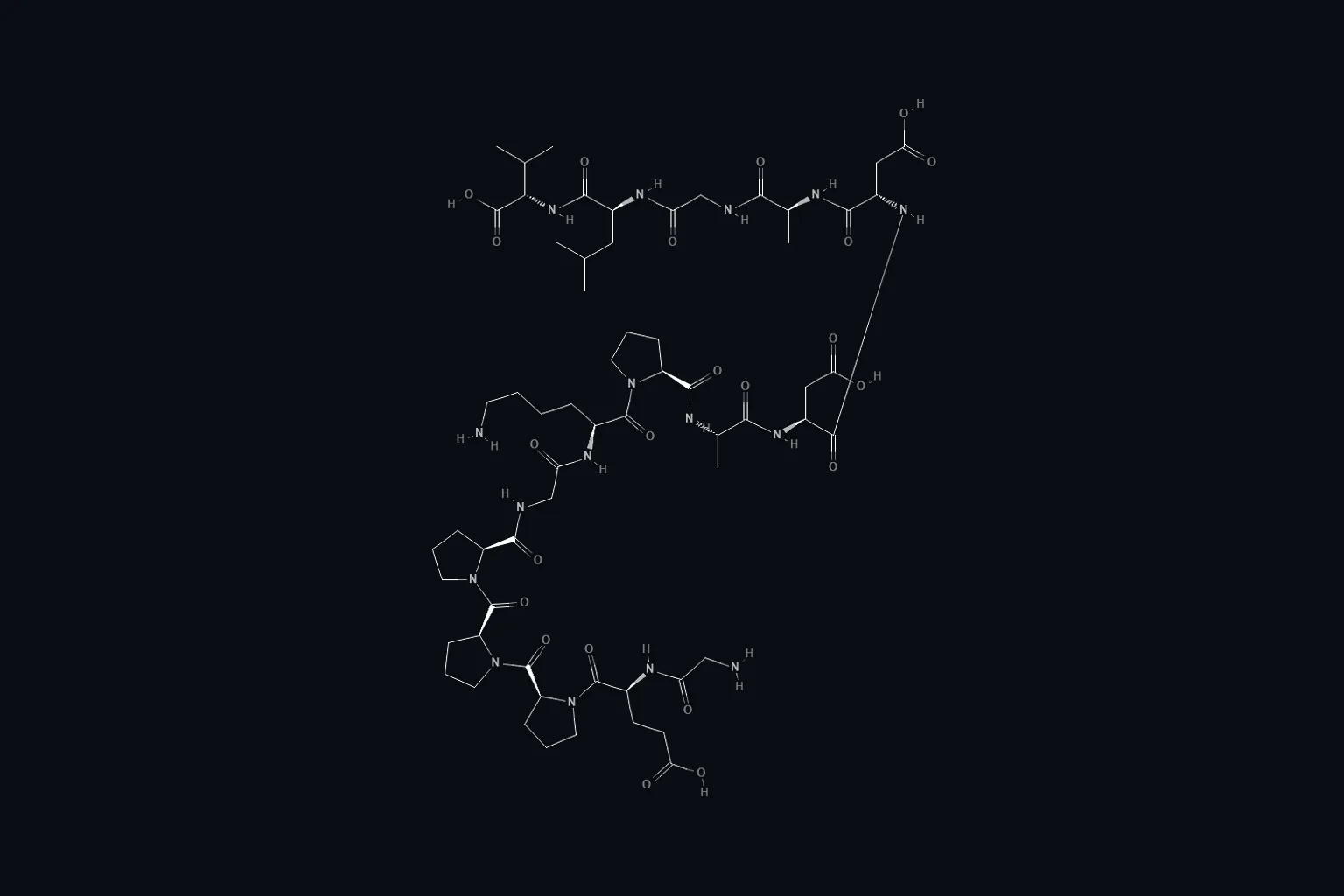
BPC-157 is a short chain of amino acids — a peptide — described in the literature as a partial sequence derived from a protein found in human gastric juice. The "BPC" stands for body protection compound, a name assigned by the researchers who first characterized it. In research settings it is synthesized in a lab rather than extracted from anything.
A few structural points come up often. It is a small molecule by protein standards, which is part of why researchers have investigated whether it survives oral administration in animal models — a question that remains an open research topic rather than a settled fact. The version circulating in commerce is usually a modified salt form, which is worth knowing mainly because the naming inconsistency in marketing is itself a signal about how unregulated this space is. Despite widespread online promotion, BPC-157 has not been approved by the FDA for any medical use.
What Researchers Have Studied It For
In animal and laboratory studies, researchers have examined whether BPC-157 influences processes involved in tissue healing. Proposed mechanisms explored in preclinical models include:
- Blood-vessel formation (angiogenesis), which is central to how injured tissue is resupplied and repaired.
- Tendon, ligament, and muscle repair in animal injury models — the origin of most athletic interest.
- Gut and gastrointestinal tissue protection in animal models, which is where the compound's research history began.
- Interaction with growth-factor and nitric-oxide signaling pathways, studied at a cellular level.
These are research questions, not proven human benefits. That distinction is the whole ballgame. Mechanistic and animal findings routinely fail to translate to people, and BPC-157 has not undergone the large, controlled human trials that would be needed to establish either safety or effectiveness for any use.
What the Evidence Actually Shows — and Doesn't
The evidence base for BPC-157 is largely preclinical: cell cultures and animal models rather than robust human clinical trials. Some animal research has reported effects on healing in specific injury models, which is why the peptide attracts attention and why the research continues.
The honest limitations are substantial:
- Human data are sparse. There is a lack of large, high-quality controlled trials in people. Not conflicting trials — largely absent ones.
- Animal results don't guarantee human results. Encouraging rodent findings frequently fail to replicate in humans. This is the norm in drug development, not the exception.
- A concentrated literature. Much of the preclinical work traces to a relatively narrow set of research groups, which is a recognized reason to want independent replication before drawing conclusions.
- Marketing outpaces science. Many online claims go well beyond anything the evidence supports, often citing animal studies as though they were human results.
We avoid citing specific figures because the underlying research is preliminary and not directly applicable to human use. Quoting a percentage from a rodent tendon model as though it forecasts your recovery would be misleading regardless of how precise the number sounds.
Why the Gap Between Hype and Evidence Is So Wide
It is worth understanding the mechanics of the hype, because they explain why BPC-157 feels better-established online than it is. Preclinical results are genuinely interesting, and interesting results get summarized, then re-summarized, and the qualifiers fall away at each step. "Improved tendon healing in a rat model" becomes "heals tendons." Meanwhile, the compound is cheap to synthesize and sells well, so there is commercial pressure pushing in the same direction.
There is also a survivorship effect in anecdotes. People who felt better post-injury — which is what injuries generally do over time, with or without intervention — write posts. People for whom nothing happened mostly do not. The result is a body of testimony that reads like evidence but cannot separate the compound from natural recovery, rest, physical therapy, or expectation.
Safety, Side Effects, and Unknowns
Because BPC-157 has not been through rigorous human safety studies, its side-effect and safety profile in people is not well characterized. For a deeper discussion, see BPC-157 Side Effects.
The key concerns:
- Unknown human safety. Long-term effects, drug interactions, and rare risks are not established. Absence of reported harm is not evidence of safety when nobody has systematically looked.
- A theoretical angiogenesis question. Because some of the proposed mechanisms involve blood-vessel formation, researchers have raised questions about what that could mean in the presence of conditions where new vessel growth is undesirable. This is an open question, not a demonstrated harm — but it is exactly the kind of question that a real trial program is designed to answer and that self-experimentation cannot.
- Unregulated products. Peptides sold as "research only" are not quality-controlled medicines; purity, sterility, actual dose, and even identity cannot be verified by a buyer.
- Injection risks. Self-administering an unapproved injectable adds contamination and infection hazards independent of the compound itself.
On dosing: there is no established human dose for BPC-157, because establishing one requires the clinical trial program that has not been done. This article provides no dosing, reconstitution, sourcing, or administration guidance, and anyone offering it is inventing it.
Legal and Regulatory Status
BPC-157 is not FDA-approved as a drug and is not a legal dietary supplement ingredient for human use. It is generally sold only for laboratory research and labeled "not for human consumption." It has also drawn regulatory attention in the compounding context, and it is prohibited in many sports under anti-doping rules — a practical concern for any competing athlete.
Using such products carries both legal and health risks. Anyone considering BPC-157 for an injury or recovery goal is better served discussing legitimate, evidence-based options with a licensed clinician — an accurate diagnosis, structured rehabilitation, and approved treatments have an evidence base that BPC-157 simply does not.
How It Compares to Other Healing Peptides
BPC-157 is most often mentioned alongside TB-500, another research peptide studied for repair-related processes. They differ in origin and proposed mechanism but share the decisive characteristic: both are research-use only, both are not FDA-approved, and both rest on preclinical rather than human evidence. See BPC-157 vs TB-500 for the side-by-side, and BPC-157 vs Semaglutide for a comparison against a genuinely approved peptide medication — a useful illustration of what an established evidence base looks like by contrast.
Where to Go From Here
For the safety picture in detail, read BPC-157 Side Effects, then step back to the category-wide frame with Are Peptides Safe?. If your underlying interest is injury recovery, Best Peptides for Healing and the healing peptides hub put BPC-157 in context alongside everything else in the category, and the BPC-157 reference page collects the essentials in one place.