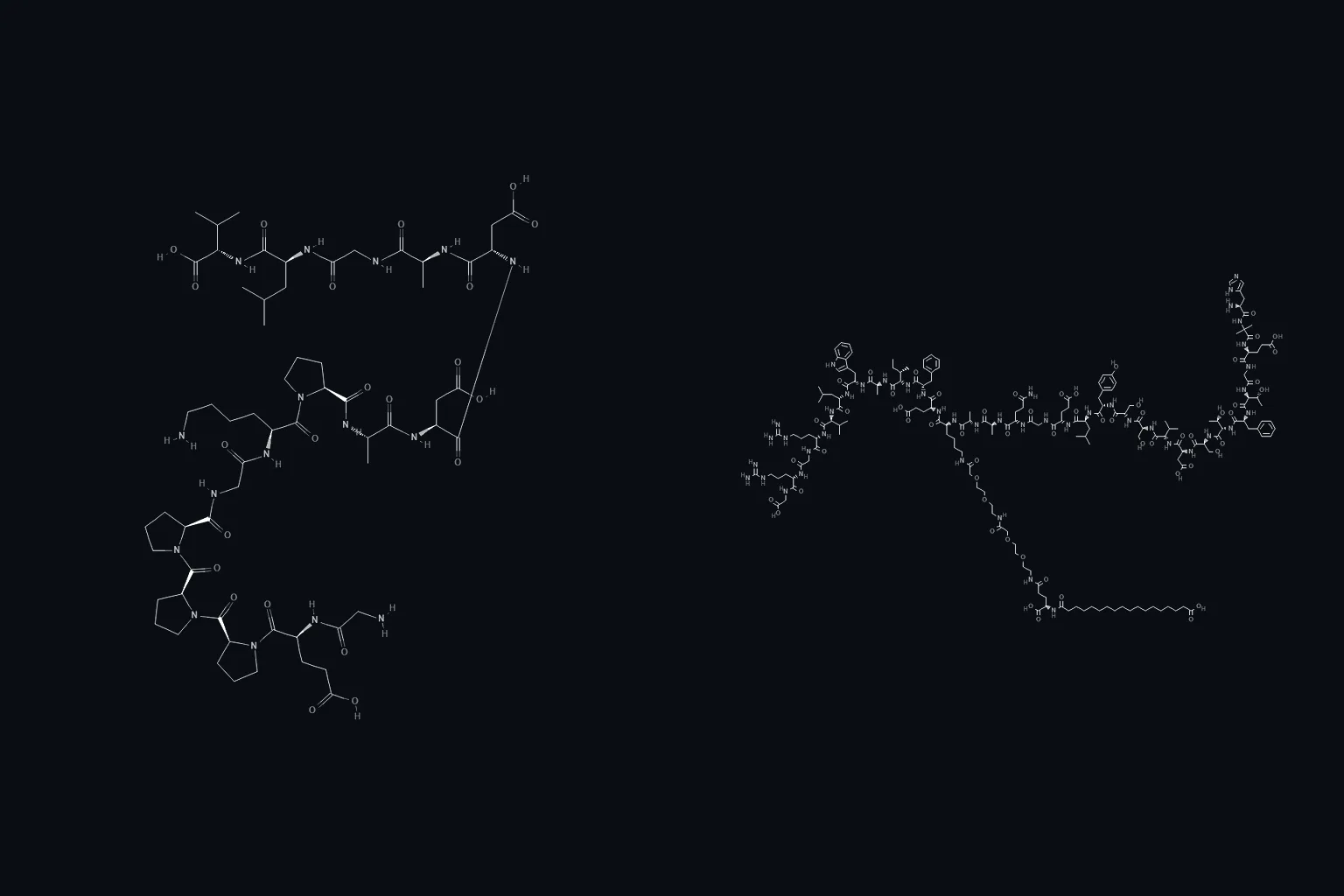
BPC-157 vs Semaglutide: Healing Peptide vs Weight-Loss Drug
BPC-157 and Semaglutide solve completely different problems — healing vs weight loss. Here's why the comparison comes up, what each actually does, and when (if ever) they're used together.
By PeptidesDB EditorialPublished Jun 18, 20264 min read
BPC-157 and Semaglutide solve completely different problems. BPC-157 is a research-use healing peptide for soft-tissue and tendon repair. Semaglutide is an FDA-approved GLP-1 receptor agonist for type 2 diabetes and obesity. They're not alternatives to each other — but they do show up together in some protocols, particularly for joint discomfort during rapid GLP-1-driven weight loss. This article covers why the comparison comes up, what each does, and the legitimate stacking pattern.
For their per-class comparisons, see BPC-157 vs TB-500 for healing and Semaglutide vs Tirzepatide for weight loss.
Quick verdict table
| BPC-157 | Semaglutide | |
|---|---|---|
| What it is | Synthetic pentadecapeptide derived from gastric protection compound | Long-acting GLP-1 receptor agonist |
| Class | Healing / regenerative peptide | Incretin mimetic |
| Primary indication | Soft-tissue repair, tendon healing, GI inflammation | Type 2 diabetes; chronic weight management |
| FDA approval | None (research-use only) | Approved 2017 (T2D), 2021 (obesity) |
| Typical dose | 250 mcg SC, 1–2× daily, 4–6 weeks | 0.25 → 2.4 mg SC weekly (titrated over 16+ weeks) |
| Mechanism | VEGF upregulation, angiogenesis, fibroblast outgrowth | GLP-1 receptor agonism — appetite, gastric emptying, insulin |
| Useful for weight loss? | No | Yes (foundational) |
| Useful for healing? | Yes (most-cited research-use option) | No |
Why the comparison comes up
Two reasons:
- Both are commonly-injected peptides that appear in research-chemical inventories and peptide-therapy clinic menus, so people new to peptides see them side-by-side and ask which is "better."
- Joint discomfort during GLP-1 weight loss. Rapid weight loss on Semaglutide or Tirzepatide can produce joint discomfort and tendon irritation, particularly in users who lose 15+% body weight in 6 months. BPC-157 shows up in some clinical practices as a supportive intervention for the joint issues.
The first reason is a category mistake — they're not alternatives. The second is a legitimate, if under-studied, stacking pattern.
What each one actually does
BPC-157
Synthesized for research in the early 1990s. Originated from a gastric-juice protective protein. Extensive animal-injury literature shows accelerated healing across tendon transection models, muscle laceration, ligament rupture, gastric/colonic ulcer models. Mechanism: VEGF upregulation drives angiogenesis; direct fibroblast outgrowth in cell culture; nitric oxide pathway involvement.
Human data is currently small case-series and observational; no completed Phase 3 trial. FDA removed BPC-157 from the 503A compoundable list in 2023 (regulatory, not safety, judgment).
For the deeper comparison with TB-500, see BPC-157 vs TB-500.
Semaglutide
GLP-1 receptor agonist; engineered for ~1-week half-life via albumin-binding fatty-acid attachment. Clinical evidence is extensive: ~15% mean weight loss at 68 weeks in STEP-1 (non-diabetic obesity), 20% relative MACE reduction in SELECT (CVD + obesity), well-characterized improvement in cardiometabolic markers across multiple trials.
FDA-approved as Ozempic (T2D) and Wegovy (obesity). Both have manufacturer-published prescribing information, robust pharmacovigilance, and standard pharmacy fulfillment.
The legitimate combination
The one place these compounds plausibly cross paths in the same protocol:
Stacking pattern: Patient on Semaglutide / Wegovy losing significant weight (>10% body weight in 6 months) develops joint discomfort or tendon irritation. Some practitioners add BPC-157 as an adjunct (250 mcg SC twice daily for 4–6 weeks) to support the connective-tissue stress of rapid weight change.
Evidence quality: Limited. The mechanism is plausible — joint discomfort during rapid weight loss is partly mechanical (changed loading patterns) and partly connective-tissue (changed body composition during rapid catabolic state). BPC-157's tendon-healing evidence applies tangentially. There's no controlled trial of the specific combination.
Risk profile: Low. BPC-157 has a favorable acute-safety profile; Semaglutide's safety is well-characterized. No known interactions.
See Wolverine Stack for the broader healing-stack frame.
When to use which
- You have an acute soft-tissue or tendon injury? BPC-157, possibly stacked with TB-500. Semaglutide is irrelevant.
- You're trying to lose meaningful weight and are within range for GLP-1 therapy? Semaglutide (or Tirzepatide). BPC-157 is irrelevant unless joint discomfort develops mid-cycle.
- You're both injured AND trying to lose weight? Treat the injury with BPC-157 (and conservative care) on its own timeline; consider GLP-1 weight-loss therapy separately under clinician supervision. Don't conflate the two goals into one stack.
- You're on Semaglutide and developed joint discomfort? BPC-157 is the most-cited supportive addition. Lifestyle factors (strength training to support joints, protein-prioritized diet to slow lean-mass loss, gradual titration) matter at least as much.
What about Tirzepatide instead of Semaglutide?
Same logic applies. Tirzepatide is the larger-effect dual-receptor option; the same joint-discomfort patterns can occur during rapid weight loss; the same BPC-157 addition rationale holds.
See Semaglutide vs Tirzepatide for the within-weight-loss comparison.
Bottom line
- Not alternatives. BPC-157 is for healing; Semaglutide is for weight loss.
- The one cross-over: BPC-157 as a supportive add-on for joint discomfort during rapid GLP-1 weight loss.
- Don't compare them as if you have to pick one. Treat each problem with the tool for that problem.
Where to go from here
- BPC-157 vs TB-500 — healing-peptide head-to-head.
- Semaglutide vs Tirzepatide — weight-loss head-to-head.
- Wolverine Stack — healing stack details.
- Weight loss stack — defensible weight-loss combinations.
- Per-peptide profiles: BPC-157, Semaglutide.
- Are peptides safe?, peptide side effects, peptide therapy.