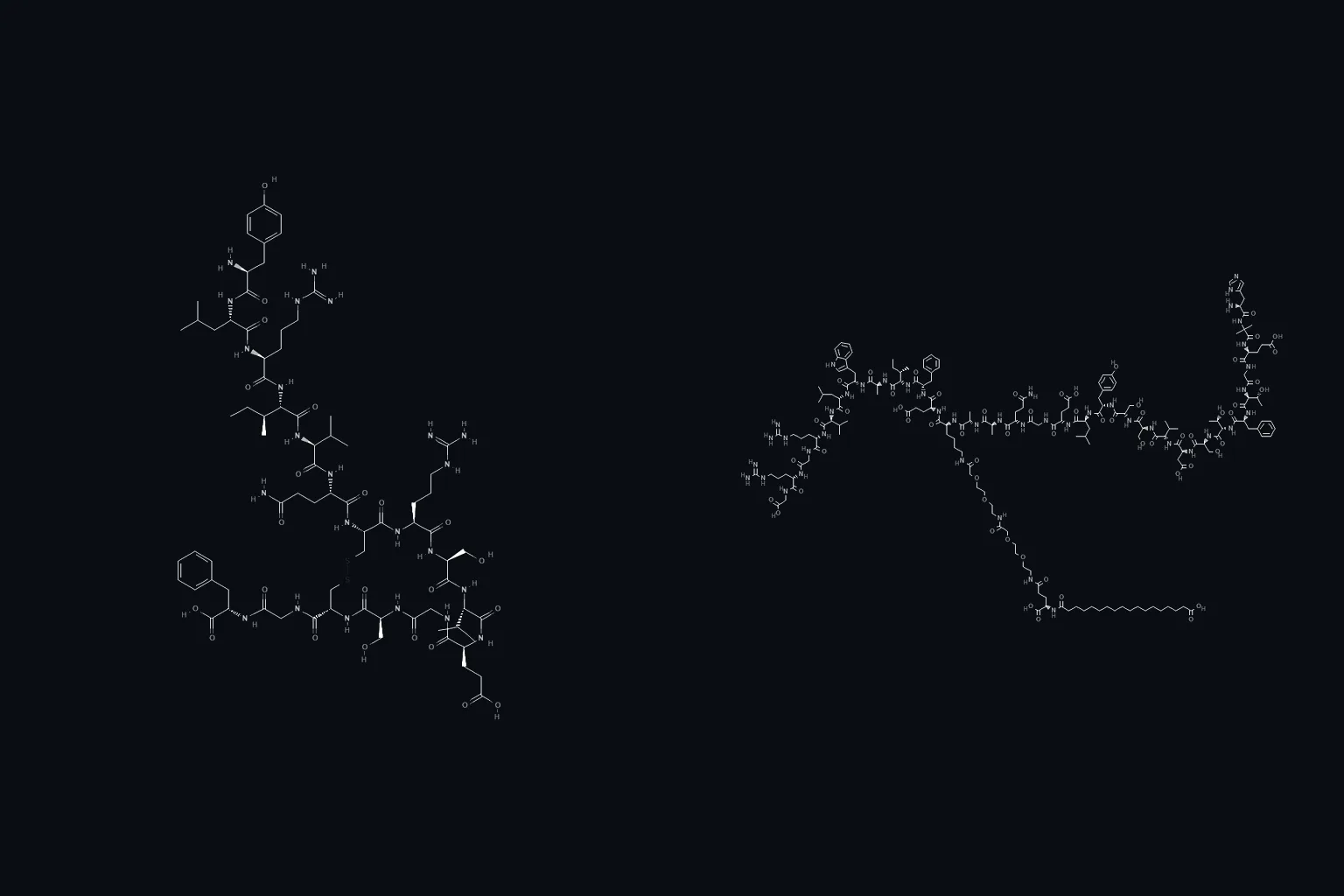
AOD-9604 vs Semaglutide: Why They're Not Comparable
AOD-9604 and Semaglutide both appear in 'fat-loss peptide' conversations but they're not comparable interventions. Semaglutide is FDA-approved with ~15% trial weight loss; AOD-9604 has weak human evidence and minimal trial effect.
By PeptidesDB EditorialPublished Jun 18, 20264 min read
AOD-9604 and Semaglutide both appear in "fat-loss peptide" conversations but they are not comparable interventions. Semaglutide is an FDA-approved GLP-1 receptor agonist with ~15% mean weight loss at 68 weeks in trials. AOD-9604 is a fragment of growth hormone (residues 176-191) marketed for fat loss; the human-trial evidence supports minimal or no weight-loss effect at safe doses. This article covers what each is, why they're not interchangeable, and where AOD-9604 might (or might not) have a real role.
For the broader frame see peptides for weight loss and best peptides for fat loss.
Quick verdict table
| AOD-9604 | Semaglutide | |
|---|---|---|
| What it is | hGH fragment 176-191 | GLP-1 receptor agonist |
| Mechanism (claimed) | Mimic GH's fat-mobilization without GH's other effects | Slow gastric emptying, suppress appetite, glucose-dependent insulin release |
| FDA approval | None (failed development for obesity) | Approved 2017 (T2D), 2021 (obesity) |
| Best published human weight-loss effect | Trivial in published trials | ~15% at 68 weeks (STEP-1) |
| Side effects | Generally mild | GI-dominated, dose-related |
| Cost (research-use) | $50–$200/month | $900–$1,400/month brand |
| Practical role | Speculative addition; minimal evidence | Foundational weight-loss tool |
What each one actually is
AOD-9604
A 16-amino-acid synthetic peptide corresponding to residues 176-191 of human growth hormone. The hypothesis: this region of GH retains the fat-mobilizing effect of the full hormone without GH's other systemic effects (IGF-1 elevation, water retention, joint discomfort, etc.).
The compound went through clinical development by Metabolic Pharmaceuticals in the 2000s as an obesity treatment. The pivotal trials showed weight loss in the AOD-9604 arms that was statistically significant in some subgroups but not clinically meaningful compared with placebo (~1–2% over 24 weeks). Development for obesity was discontinued.
Semaglutide
A long-acting GLP-1 receptor agonist. The mechanism is well-characterized: appetite suppression, slowed gastric emptying, glucose-dependent insulin release. The STEP clinical-trial program established ~15% mean weight loss at 68 weeks in non-diabetic obesity; the SELECT trial established 20% relative MACE reduction. FDA-approved as Ozempic (T2D) and Wegovy (obesity).
Why they're not comparable
- Mechanism class. GLP-1 receptor agonism is a robust, multiply-confirmed mechanism for appetite suppression and weight loss. GH-fragment "fat mobilization" was a hypothesis that didn't deliver clinically meaningful effect in development trials.
- Evidence quality. Semaglutide has Phase 3 data in tens of thousands of patients. AOD-9604 has small Phase 2 data that didn't meet primary endpoints for obesity.
- Effect size. ~15% vs ~1–2% at maintenance trial timepoints.
- Regulatory status. Approved drug vs research-use compound that failed obesity development.
When (if ever) AOD-9604 has a role
The honest answer: at most a speculative supportive role. The places it shows up in protocols:
- Combined with caloric restriction as a "fat-burner" addition. There's no published evidence the addition produces measurable weight loss beyond what caloric restriction produces alone.
- As an adjunct to GH-axis peptides (Ipamorelin / CJC-1295 / MK-677) for body-composition focus. Adds cost; doesn't add evidence-supported effect.
- As a "less-systemic" alternative to HGH for users who want fat-mobilization effects without the GH side-effect profile. The evidence doesn't support this trade-off — you're trading real GH effects (which include real risks) for minimal AOD-9604 effect.
None of these have published evidence behind them. The realistic frame is that AOD-9604 is, at the doses typically used, near-placebo.
What about combining AOD-9604 with Semaglutide?
Some research-chemical protocols add AOD-9604 to a GLP-1. There is no clinical evidence that this combination produces more weight loss than Semaglutide alone. The cost adds; the side-effect surface adds (mildly); the measurable benefit does not.
If you want to add a complementary-mechanism peptide on top of Semaglutide, the evidence-supported options are:
- Cagrilintide — different mechanism (amylin), Phase 3 data on the combination (CagriSema).
- Tesamorelin — GHRH analog, specifically targets visceral fat reduction; FDA-approved for HIV lipodystrophy.
Both have real published rationale. AOD-9604 does not.
What about Tesamorelin instead?
Tesamorelin is FDA-approved as a GHRH analog for visceral fat reduction in HIV-associated lipodystrophy. The on-label evidence is specifically visceral adipose tissue reduction (not whole-body weight loss). Off-label use for body-composition purposes is widespread; clinical evidence outside the lipodystrophy indication is weaker than the on-label evidence but is meaningful.
For users specifically looking for a peptide-class addition to GLP-1 therapy for body-composition reasons, Tesamorelin is a more defensible option than AOD-9604.
Bottom line
- Semaglutide is the foundational tool. AOD-9604 is largely a placebo for weight loss at safe doses.
- They are not equivalent and shouldn't be compared as alternatives.
- If you're building a stack: GLP-1 + Cagrilintide (CagriSema) or GLP-1 + Tesamorelin are the evidence-supported pairings, not GLP-1 + AOD-9604.
Where to go from here
- Peptides for weight loss — the cornerstone guide.
- Best peptides for fat loss — ranked roundup.
- Semaglutide vs Tirzepatide, Ozempic vs Wegovy — comparisons among real options.
- Weight loss stack — evidence-supported stacking patterns.
- Per-peptide profiles: AOD-9604, Semaglutide, Tesamorelin, Cagrilintide.
- Are peptides safe?, peptide side effects, peptide therapy.