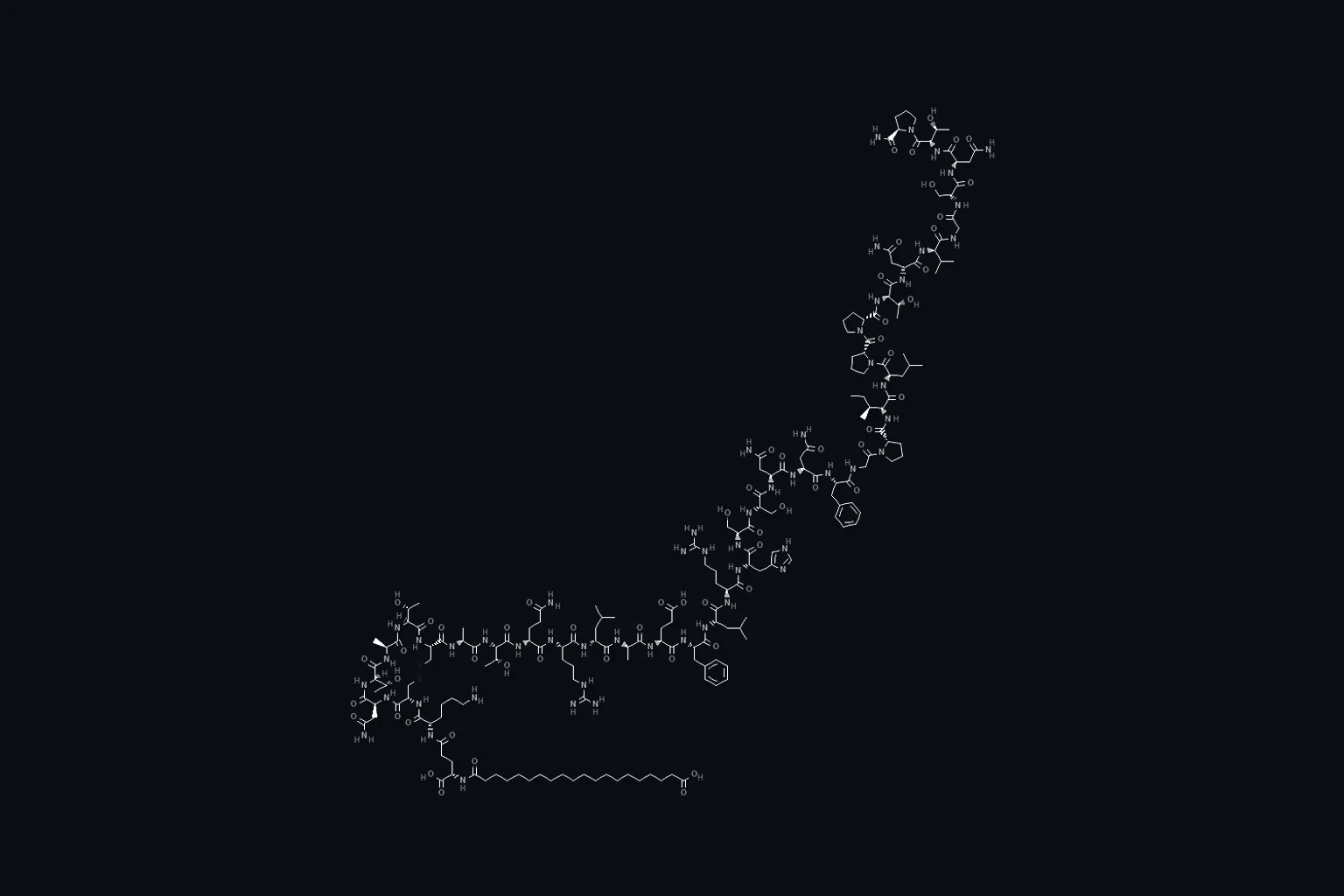
Cagrilintide Explained: Amylin Agonist + CagriSema Combination
Cagrilintide (AM833) is Novo Nordisk's long-acting amylin receptor agonist. Combined with Semaglutide it produces ~17–22% weight loss in Phase 3 trials with a different mechanism than GLP-1.
By PeptidesDB EditorialPublished Jun 14, 20264 min read
Cagrilintide (AM833) is Novo Nordisk's long-acting amylin receptor agonist — the same hormone family as the natural pancreatic peptide amylin. As a monotherapy it produces ~10% weight loss; the headline combination, CagriSema (Cagrilintide + Semaglutide), has produced 15–22% weight loss in Phase 3 trials depending on cohort and dose. The strategic significance: a different-mechanism complement to GLP-1 agonism that does not duplicate the GLP-1 side-effect profile.
For the per-peptide research profile, see Cagrilintide. For the broader weight-loss landscape, see peptides for weight loss.
What it is
Amylin is a 37-amino-acid peptide hormone co-secreted with insulin by pancreatic β-cells. It slows gastric emptying, suppresses post-meal glucagon, and amplifies satiety signaling to the brain. It works in parallel with insulin and GLP-1 to control post-meal glucose and appetite.
The natural amylin half-life is short (minutes). Pramlintide (an older synthetic amylin analog) is dosed multiple times per day. Cagrilintide is engineered for once-weekly dosing — same mechanism, much longer-lived molecule.
Why amylin + GLP-1 is a real combination
GLP-1 receptors and amylin receptors are in different cell populations and different brain regions. Activating both gives the body two parallel satiety signals via partially independent circuits. The mechanism isn't redundant; the combined effect is meaningfully larger than either alone.
This is the same reason GLP-1 + GIP (Tirzepatide) works better than GLP-1 alone — different upstream input to overlapping downstream behavior. The amylin combination adds a third axis from a different family.
What the data shows
Cagrilintide monotherapy (Phase 2):
- ~10% weight loss at 26 weeks at the 4.5 mg weekly dose.
CagriSema (Cagrilintide + Semaglutide combination, Phase 3 REDEFINE program):
- REDEFINE-1 (adults with obesity, no T2D): ~22% weight loss at 68 weeks at the maintenance dose.
- REDEFINE-2 (adults with obesity and T2D): ~15% weight loss at 68 weeks, plus T2D-relevant A1C improvement.
- Better than Semaglutide alone in head-to-head; smaller than the headline Tirzepatide numbers at maximum dose.
The 2024 Phase 3 read missed some pre-trial Wall Street expectations (Wall Street had been pricing in >25% weight loss), causing significant stock movement, but the clinical numbers are in line with what the Phase 2 data predicted.
Side-effect profile
Cagrilintide monotherapy:
- Common: Mild nausea, occasional vomiting. The amylin class is generally better tolerated than GLP-1 monoagonists.
- Notable: Injection-site reactions, occasional headache.
CagriSema combination:
- Side-effect profile broadly that of Semaglutide alone — nausea, vomiting, diarrhea, constipation — with the Cagrilintide component adding modestly to GI symptoms at peak doses.
- The combination's tolerability does not appear dramatically worse than Semaglutide alone, which is the strategic win: more weight loss without proportionally more side effects.
Where it stands
As of mid-2026:
- Cagrilintide monotherapy is in late-stage development.
- CagriSema is in Phase 3; Novo's stated target is FDA submission in 2026 with potential approval in 2027.
- Novo's commercial strategy positions CagriSema as the next-generation Wegovy successor, particularly for patients who plateau or don't tolerate Semaglutide at maximum dose.
How it compares to other options
| Semaglutide | Tirzepatide | CagriSema (Phase 3) | Retatrutide (Phase 3) | |
|---|---|---|---|---|
| Mechanism | GLP-1 | GIP + GLP-1 | Amylin + GLP-1 | GLP-1 + GIP + glucagon |
| Approval | FDA-approved | FDA-approved | Phase 3, not approved | Phase 3, not approved |
| Weight loss (best trial) | ~15% | ~21% | ~22% | ~24% |
| Mechanism complement to GLP-1 | n/a | Same family (incretins) | Different family (amylin) | Different family (glucagon) |
The strategic distinction between CagriSema and Tirzepatide / Retatrutide: CagriSema's complement mechanism is amylin, not incretin. For patients who don't respond well to incretin amplification, the amylin axis is the differentiated path.
Open questions
- Long-term safety. Amylin-receptor agonism at chronic exposure is less-studied than GLP-1; the Phase 3 reads + post-market surveillance will fill this in.
- Cost and access. Combination products generally price above the more-expensive component; Wegovy-equivalent pricing is the floor expectation.
- Real-world adherence. Trial discontinuation rates were higher in CagriSema than Semaglutide-only arms; real-world adherence to the combination may be a meaningful constraint.
Cagrilintide monotherapy use cases
Even without CagriSema, Cagrilintide as monotherapy may have a niche:
- Patients intolerant to GLP-1s. Amylin's side-effect profile is genuinely different.
- Patients who plateau on Semaglutide or Tirzepatide. Switching mechanism class may unlock additional weight loss.
- Maintenance after primary weight loss on a different agent. Amylin's tolerability profile may be more sustainable long-term.
These are speculative use cases until Cagrilintide is broadly available.
Where to go from here
- Cagrilintide research profile with study citations.
- Peptides for weight loss — broader guide.
- Best peptides for fat loss — ranked roundup.
- Retatrutide explained — the other Phase 3 contender.
- Are peptides safe?, peptide side effects — safety frame.
This is an informational summary of published trial data, not medical advice. CagriSema is not currently FDA-approved.